Vehicle Registration Certificate (RC) in India: Complete Guide for Vehicle Owners (2026)
Learn everything about the Vehicle Registration Certificate — purpose, details, types, validity, renewal, duplicate RC, digital RC, and expert tips.
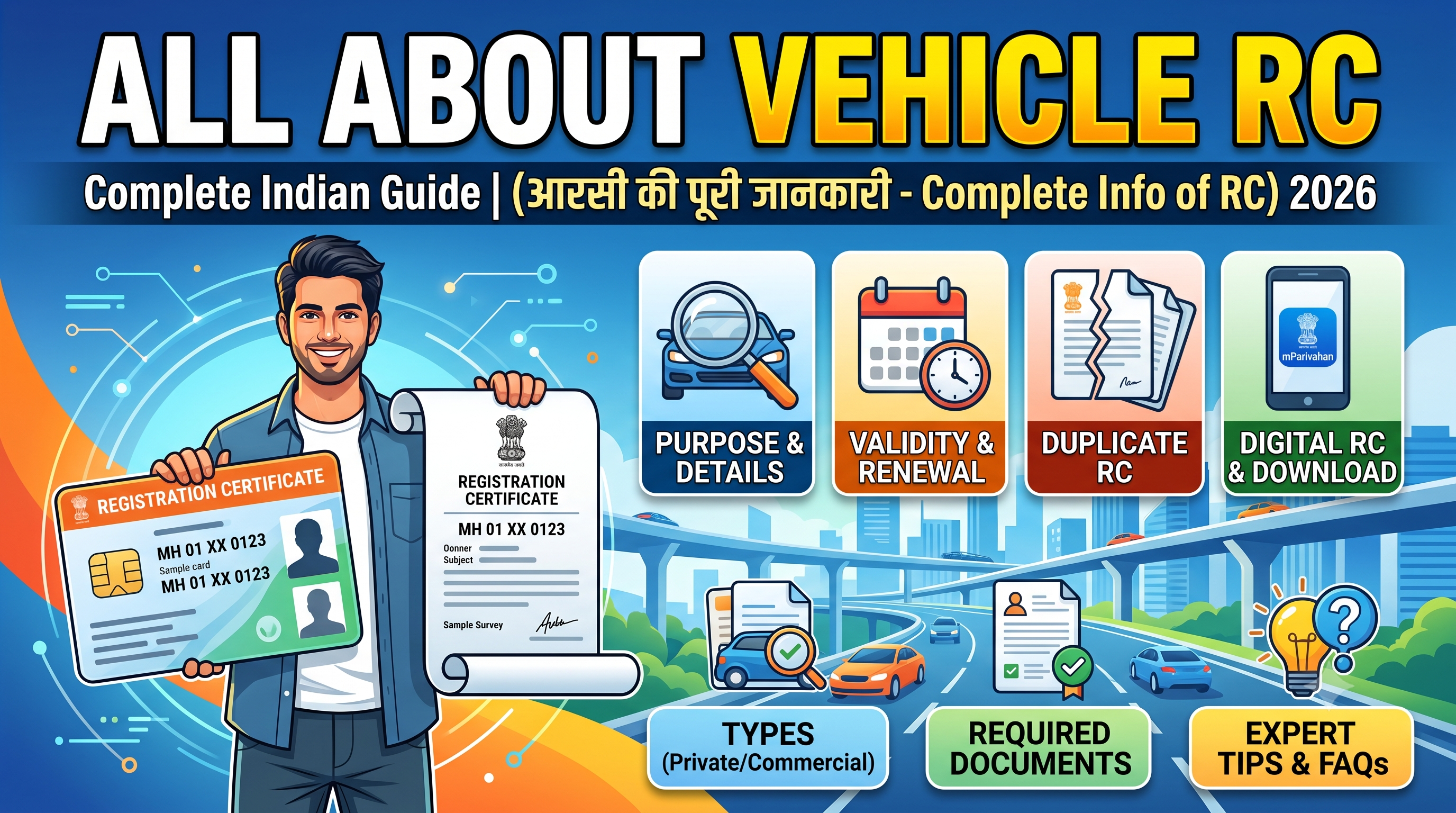
Quick Answer
A Vehicle Registration Certificate (RC) is an official document issued by the Regional Transport Office (RTO) that legally proves a vehicle is registered under the Motor Vehicles Act. Every vehicle driven on public roads in India must have a valid RC containing details such as the owner's name, registration number, chassis number, engine number, fuel type, registration validity, and other essential vehicle information.
What is a Vehicle Registration Certificate?
A Vehicle Registration Certificate (commonly known as an RC) is one of the most important legal documents for every vehicle owner in India. Whether you own a motorcycle, scooter, car, SUV, commercial vehicle, or electric vehicle, an RC serves as official proof that your vehicle has been registered with the Regional Transport Office (RTO).
Once a vehicle is registered, the RTO assigns a unique registration number and records important details in the national vehicle database. The Registration Certificate is then issued to the vehicle owner as proof that the registration process has been successfully completed.
Unlike a purchase invoice or insurance policy, an RC establishes the legal identity of a vehicle. It connects the registration number, chassis number, engine number, and owner's information into one officially recognized document.
Without a valid Registration Certificate, a vehicle cannot legally be driven on public roads.
Why is a Registration Certificate Important?
Many people believe an RC is just another vehicle document. In reality, it plays a much bigger role.
A valid Registration Certificate helps establish ownership, simplifies legal verification, supports insurance claims, and is required for several RTO-related services throughout a vehicle's lifecycle.
Some of the most common situations where an RC is required include:
| Purpose | Why RC is Needed |
|---|---|
| Traffic Police Verification | Confirms legal registration of the vehicle |
| Vehicle Insurance Claims | Verifies ownership and registration details |
| Selling a Vehicle | Required during ownership transfer |
| Loan Verification | Financial institutions may verify vehicle ownership |
| Fitness & Compliance | Used during inspections and renewals |
| Vehicle Identification | Matches registration number with chassis and engine details |
Apart from legal compliance, keeping your RC updated helps avoid unnecessary delays when dealing with vehicle documentation or ownership-related processes.
What Information is Printed on an RC?
Although the design may differ slightly between states, most Registration Certificates contain similar information.
Typical details include:
- Registration Number
- Vehicle Owner's Name
- Parent/Guardian Name (where applicable)
- Permanent Address
- Vehicle Class
- Vehicle Category
- Fuel Type
- Engine Number
- Chassis Number
- Manufacturer Name
- Vehicle Model
- Manufacturing Year
- Registration Date
- Registration Validity
- Seating Capacity
- Colour
- Cubic Capacity (CC)
- Unladen Weight
- Gross Vehicle Weight (Commercial Vehicles)
- Emission Standard
- Hypothecation Details (if financed)
- RTO Office Details
Every detail serves a specific purpose during verification, insurance, resale, or legal procedures.
Different Types of Registration Certificates
Over the years, vehicle registration documents in India have evolved.
Paper RC Book
Older vehicles were issued a paper-based RC book containing printed vehicle information. While still valid if officially issued, many states have transitioned away from paper booklets in favor of digital records and smart cards.
Smart Card RC
Most modern vehicles receive a PVC smart card that securely stores vehicle information. Smart Cards are more durable, easier to carry, and less prone to damage compared to traditional paper RC books.
Digital RC
With the introduction of digital governance, vehicle owners can also access a digitally stored Registration Certificate through approved government-backed platforms such as DigiLocker and mParivahan. In many situations, these digital documents are accepted alongside physical copies, subject to applicable rules and verification requirements.
Related Guides
You may also find these resources useful:
- Check your Registration Certificate details → https://rcdownloads.com/rc-status
- Replace a lost or damaged Registration Certificate → https://rcdownloads.com/duplicate-rc
- Learn about renewing your vehicle's Registration Certificate → https://rcdownloads.com/rc-renewal-online
How RC is Issued
The Registration Certificate is issued after a vehicle completes the official registration process with the Regional Transport Office (RTO). The process may vary slightly by state, but the general steps remain similar across India.
For a new vehicle, the RC issuance process typically involves:
- Vehicle purchase and collection of required documents from the dealer
- Submission of registration application (Form 20 and related forms) to the RTO
- Payment of applicable registration fees and road tax
- Vehicle inspection and verification of chassis and engine numbers
- Assignment of a unique registration number by the RTO
- Entry of vehicle and owner details into the national vehicle database (VAHAN)
- Issuance of the Registration Certificate — paper RC book, smart card, or both depending on state policy
- Dispatch or collection of the RC by the vehicle owner
For used vehicles or ownership transfers, a new RC is issued after the transfer application is approved and updated owner details are recorded in the RTO system.
RC Validity
A Registration Certificate is not valid forever. Every RC has a defined validity period, after which renewal or compliance procedures must be completed to keep the vehicle legally registered.
Private Vehicles (Cars, Bikes, Scooters)
For most private vehicles in India, the Registration Certificate is valid for 15 years from the date of registration. After this period, RC renewal is mandatory to continue using the vehicle on public roads. Subsequent renewals are typically required every 5 years, subject to fitness and RTO rules.
Commercial Vehicles
Commercial vehicles are subject to stricter compliance requirements, including periodic fitness certificates and more frequent renewals. Validity and renewal timelines depend on vehicle category, age, and state transport regulations.
Driving with an expired Registration Certificate can result in penalties, fines, and legal complications. Vehicle owners should monitor the registration validity date printed on the RC and plan renewal in advance.
Digital RC vs Physical RC
Vehicle owners in India can now access their Registration Certificate in both physical and digital formats. Understanding the difference helps you choose the most convenient option for everyday use.
| Feature | Physical RC | Digital RC |
|---|---|---|
| Format | Paper RC book or PVC smart card | PDF or app-based document via DigiLocker / mParivahan |
| Portability | Must be carried physically or kept safely at home | Accessible anytime on smartphone |
| Durability | Paper RC can tear or fade; smart cards are more durable | No physical wear — stored digitally |
| Verification | Verified by inspecting the physical document | Verified via QR code or official app login |
| Acceptance | Universally accepted when valid and original | Accepted in many situations per government guidelines |
| Best For | RTO visits, offline verification, long-term records | Traffic checks, quick access, insurance and resale |
Many vehicle owners keep both — a physical smart card for official purposes and a digital copy on mParivahan or DigiLocker for everyday convenience. Always ensure your digital RC is fetched from an official government-backed platform.
Common RC Problems
Vehicle owners often face Registration Certificate-related issues. Recognizing these problems early can save time and prevent legal complications.
Lost or Damaged RC
A lost, stolen, or physically damaged RC must be replaced through a duplicate RC application on the Parivahan portal.
Expired Registration
Driving with an expired RC is illegal. Renewal must be completed before or after expiry, often including a fitness inspection.
Incorrect Owner Details
Wrong name, address, or vehicle information on the RC requires an RC correction application through the RTO.
Hypothecation Not Removed
If a vehicle loan is closed but the RC still shows hypothecation, a hypothecation termination application is needed.
RC Not Updated After Transfer
After selling or buying a vehicle, the RC must reflect the new owner. Delays in transfer can cause legal and insurance issues.
RC Status Delays
Applications for new RC, renewal, or duplicate may show pending status. Track progress via Parivahan or Vahan portals.
Expert Tips
Follow these practical tips to manage your Vehicle Registration Certificate effectively and avoid common documentation issues.
Always verify RC details immediately after purchasing a new or used vehicle — check registration number, chassis number, engine number, and owner name.
Store a digital copy of your RC on DigiLocker or mParivahan for quick access during traffic checks or emergencies.
Keep your RC updated — renew before the 15-year validity expires for private vehicles to avoid penalties.
Never rely on unofficial websites or agents for RC services. Use only Parivahan, Vahan, DigiLocker, and mParivahan.
If your RC is lost, file an FIR (where required) and apply for duplicate RC promptly to stay legally compliant.
Remove hypothecation from your RC after closing a vehicle loan to simplify resale and future transfers.
Check RC status online if your application for renewal, duplicate, or transfer is taking longer than expected.
FAQs
A Vehicle Registration Certificate is an official document issued by the RTO that proves a vehicle is legally registered under the Motor Vehicles Act. It contains the registration number, owner details, chassis and engine numbers, and registration validity.
Yes. A digitally stored Registration Certificate accessed through approved government-backed platforms such as DigiLocker and mParivahan is accepted in many situations alongside physical copies, subject to applicable rules and verification requirements.
For private vehicles in India, the Registration Certificate is generally valid for 15 years from the date of registration. After that period, RC renewal is required to continue using the vehicle legally on public roads.
If your Registration Certificate is lost, stolen, or damaged, you should apply for a duplicate RC through the official Parivahan portal. Required documents may include FIR copy (if lost), valid insurance, PUC certificate, and identity proof.
A paper RC book is the older format with printed vehicle information. A smart card RC is a modern PVC card that stores the same details in a durable, chip-based format. Both are valid when officially issued, though many states now prefer smart cards and digital records.
Insurance companies use the Registration Certificate to verify vehicle ownership, registration number, chassis and engine details, and registration validity before processing claims or policy-related requests.