Vehicle Fitness Certificate Online | Download, Renewal, Validity & Status
Everything You Need to Know About Vehicle Fitness Certificates
- Download Fitness Certificate
- Fitness Certificate Renewal
- Validity Period
- Online Status Check
- Inspection Process
- Fees & Documents
- RC Renewal Requirements
- Commercial & Private Vehicles
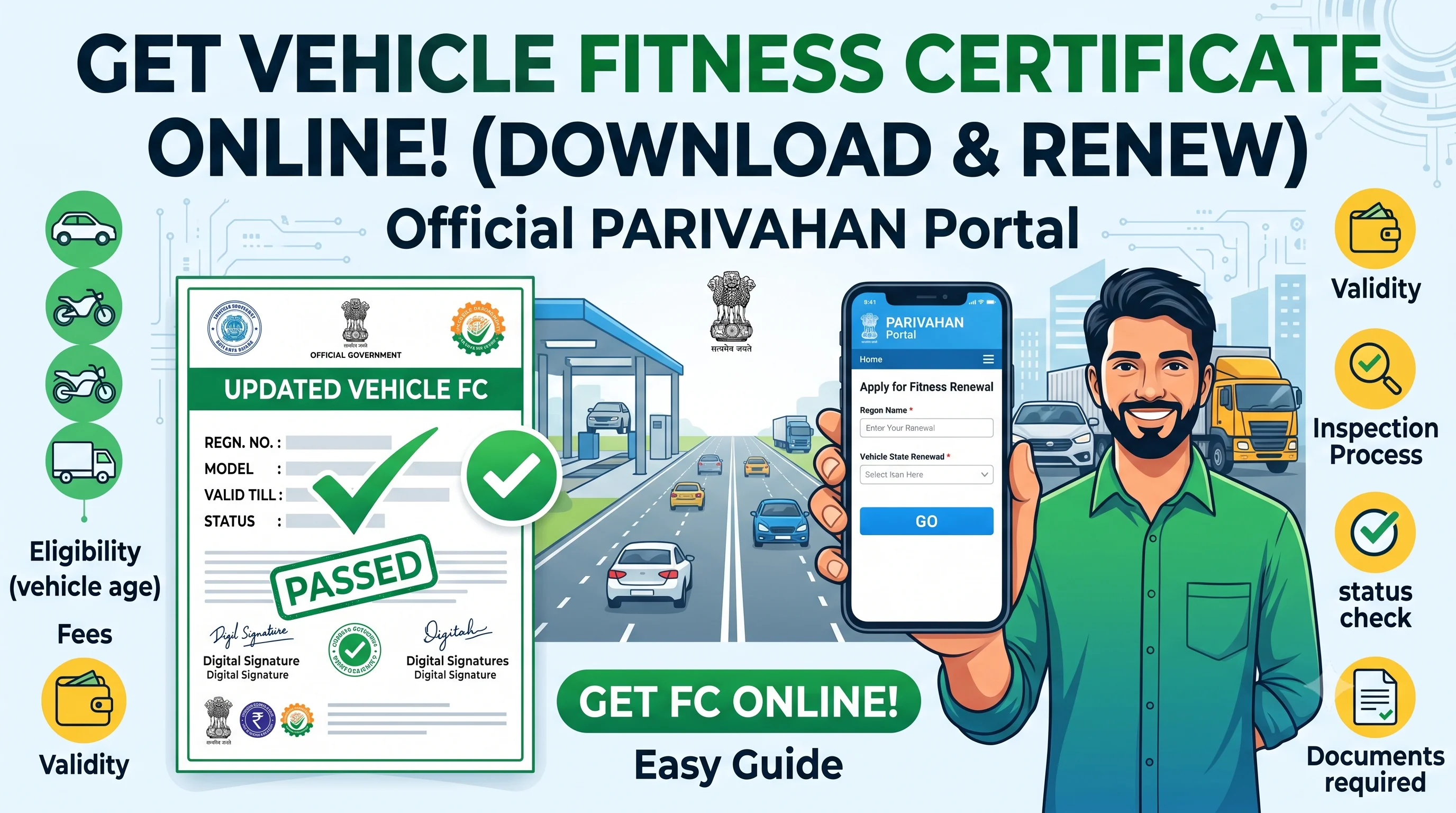
Start on the official Parivahan portal
Opens the official Parivahan portal in a new tab.
Quick Answer
A Vehicle Fitness Certificate (FC) is an official document issued by the Regional Transport Office (RTO) confirming that a vehicle meets the prescribed roadworthiness and safety standards. It is an important requirement for many transport-related services and helps ensure that vehicles operating on public roads comply with applicable regulations.
Depending on your vehicle category and the applicable transport rules, you may need a valid Fitness Certificate when renewing your Registration Certificate (RC), operating certain vehicles, or completing other RTO services.
After your certificate is approved, you can Check RC Status to monitor related applications and Download RC Online once your Registration Certificate has been updated, where applicable.
Quick Action Center
| Need Help? | Go Here |
|---|---|
| Check Vehicle Information | RC Details |
| Track Application | RC Status |
| Renew Registration Certificate | RC Renewal |
| Download Updated RC | RC Download |
| Verify Vehicle Information | RC Verification |
Fitness Certificate Overview
| Details | Information |
|---|---|
| Service | Vehicle Fitness Certificate |
| Issued By | Regional Transport Office (RTO) |
| Portal | Parivahan |
| Mode | Online & Offline |
| Applicable Vehicles | Depends on vehicle category and applicable rules |
| Renewal | Required where applicable |
| Status | Can be tracked online |
| Certificate | Download after approval |
Did You Know?
A Fitness Certificate is different from a Pollution Under Control (PUC) Certificate. A PUC Certificate measures vehicle emissions, while a Fitness Certificate evaluates the vehicle's overall roadworthiness based on applicable inspection standards.
Many vehicle owners mistakenly believe these two certificates serve the same purpose—they do not.
What is a Vehicle Fitness Certificate?
A Vehicle Fitness Certificate confirms that a vehicle has met the inspection standards prescribed by the transport authority for the applicable vehicle category.
During the inspection, the vehicle may be evaluated for several safety and operational aspects depending on the applicable rules and inspection procedure.
The objective is to help ensure that vehicles using public roads meet the required safety standards.
If you're planning to renew your Registration Certificate, first review your vehicle information through RC Details to make sure your records are accurate before beginning the process.
Why is a Fitness Certificate Important?
A valid Fitness Certificate can help:
- Demonstrate that the vehicle has passed the required inspection.
- Support compliance with applicable transport regulations.
- Facilitate certain vehicle-related services.
- Improve confidence during vehicle resale.
- Help avoid delays in related RTO processes.
- Assist in RC Renewal where applicable.
Maintaining a valid Fitness Certificate also contributes to safer roads by encouraging regular vehicle inspections and maintenance.
When Do You Need a Fitness Certificate?
Different situations may require a valid Fitness Certificate depending on the vehicle category and the applicable transport rules.
Some common scenarios include:
RC Renewal
In certain cases, a valid Fitness Certificate may be required as part of the Registration Certificate renewal process.
If your Registration Certificate is nearing expiry, learn about RC Renewal before applying.
Commercial Vehicle Operations
Commercial vehicles may require periodic Fitness Certificate renewal in accordance with applicable regulations.
Vehicle Inspection
Some transport-related services may require the vehicle to undergo inspection before a Fitness Certificate can be issued or renewed.
Ownership Transfer (Where Applicable)
Certain situations may require a valid Fitness Certificate when completing vehicle-related formalities.
Before starting RC Transfer, review the applicable requirements for your vehicle category.
Common Scenario 1
My Vehicle Has Completed the Applicable Registration Period
↓ Check your vehicle details using RC Details
↓ Determine whether a Fitness Certificate is required under the applicable rules.
↓ Schedule vehicle inspection.
↓ Receive approval (if inspection is successful).
↓ Proceed with RC Renewal if applicable.
↓ Download the updated Registration Certificate through RC Download.
Common Scenario 2
Commercial Vehicle Fitness Renewal
↓ Existing Fitness Certificate nearing expiry.
↓ Book inspection.
↓ Vehicle inspection completed.
↓ Fitness Certificate renewed.
↓ Continue operating the vehicle in accordance with applicable regulations.
Who Needs a Fitness Certificate?
Depending on the applicable transport rules, a Fitness Certificate may be required for:
- Commercial vehicles.
- Transport vehicles.
- Vehicles undergoing specific RTO procedures.
- Certain private vehicles where required under law.
Always check the latest rules applicable to your vehicle type and state before applying.
Benefits of Having a Valid Fitness Certificate
Improved Road Safety
Regular inspections help identify safety-related issues that should be addressed before the vehicle is used on public roads.
Easier RC Renewal
Where applicable, a valid Fitness Certificate can support the Registration Certificate renewal process.
Better Vehicle Maintenance
Periodic inspections encourage owners to maintain their vehicles in good working condition.
Greater Buyer Confidence
If you're selling a vehicle, having a valid Fitness Certificate may provide additional confidence to prospective buyers.
Before selling, many owners also perform RC Verification and complete RC Transfer after the sale.
What is Checked During Vehicle Inspection?
The inspection process may include checks such as:
- Brake performance.
- Steering system.
- Tyres.
- Suspension.
- Headlights.
- Indicators.
- Horn.
- Windshield and mirrors.
- Chassis condition.
- Safety equipment.
- Vehicle identification details.
The exact inspection procedure depends on the applicable regulations and vehicle category.
Vehicle Inspection Checklist
Before visiting the inspection centre, make sure you check:
- Registration Certificate
- Insurance Certificate
- Pollution Under Control (PUC) Certificate
- Tax documents (where applicable)
- Working headlights
- Functional brake lights
- Proper tyre condition
- Horn working properly
- Mirrors fitted correctly
- Windshield in good condition
- No major oil leaks
- Chassis number clearly visible
Preparing your vehicle in advance can help reduce the chances of inspection delays or repeat visits.
Fitness Certificate vs PUC Certificate
| Fitness Certificate | PUC Certificate |
|---|---|
| Confirms overall roadworthiness based on applicable inspection standards. | Confirms that emissions are within prescribed limits. |
| Covers multiple safety and operational aspects. | Focuses only on pollution levels. |
| Issued after vehicle inspection where required. | Issued after an emission test. |
| May be required for certain RTO services. | Required under pollution control regulations. |
How to Apply for a Vehicle Fitness Certificate Online
Depending on your state's transport department and the type of vehicle, you may be able to begin the Fitness Certificate application through the official Parivahan portal. In many cases, the online process allows you to submit an application, upload documents, pay the prescribed fee, and schedule an inspection if required.
Although the application may begin online, the vehicle itself generally needs to be inspected before a Fitness Certificate can be issued or renewed.
Before applying, verify your vehicle information using RC Details to ensure your Registration Certificate contains accurate information.
Step-by-Step Process to Apply Online
Step 1 – Visit the Official Parivahan Portal
Open the official Vehicle Related Services portal and choose your state or Regional Transport Office (RTO).
Always use the official government portal for vehicle-related services.
Step 2 – Select the Fitness Certificate Service
Navigate to the vehicle services section and choose the Fitness Certificate or Fitness Renewal service available for your vehicle.
Select the correct vehicle before continuing.
Step 3 – Enter Vehicle Details
Provide your:
- Registration Number
- Chassis Number (if requested)
- Engine Number (if requested)
Review the information carefully before proceeding.
Step 4 – Upload Required Documents
Upload the required supporting documents.
Depending on your application, these may include:
- Registration Certificate
- Insurance Certificate
- Pollution Under Control (PUC) Certificate
- Identity Proof (where required)
- Other documents requested by the RTO
Ensure that all documents are clear and valid.
Step 5 – Pay the Applicable Fee
Complete the payment using the available online payment options.
Keep a copy of the acknowledgement and payment receipt for future reference.
Step 6 – Schedule Vehicle Inspection
If required, book an inspection appointment.
Arrive at the inspection centre with the vehicle and original documents.
Step 7 – Vehicle Inspection
During inspection, the transport authority may examine several aspects of the vehicle to determine whether it satisfies the applicable roadworthiness standards.
If the vehicle meets the required standards, the application proceeds for approval.
Step 8 – Receive Approval
Once approved, your Fitness Certificate becomes available according to your state's process.
You can then continue with other vehicle-related services such as RC Renewal where applicable.
Offline Application Process
If online services are unavailable, you can visit the concerned Regional Transport Office.
The general process includes:
- Visit the RTO.
- Collect the Fitness Certificate application form.
- Fill in the required details.
- Attach supporting documents.
- Pay the applicable fee.
- Present the vehicle for inspection.
- Complete verification.
- Receive the approved certificate.
Documents Required
Although requirements vary by state and vehicle category, applicants should generally keep:
| Document | Required |
|---|---|
| Registration Certificate | ✅ |
| Insurance Certificate | ✅ |
| Pollution Under Control (PUC) Certificate | ✅ |
| Identity Proof | Where Applicable |
| Address Proof | If Requested |
| Previous Fitness Certificate | Renewal Cases |
| Application Form | ✅ |
| Fee Receipt | ✅ |
Before visiting the RTO, make sure your Registration Certificate information is accurate. If you find incorrect details, complete RC Correction before proceeding.
Vehicle Fitness Certificate Validity
The validity period depends on:
- Vehicle category.
- Applicable transport regulations.
- Type of Fitness Certificate issued.
Because these rules may change over time and differ between vehicle categories, always verify the current validity period applicable to your vehicle through the official transport authority.
Fitness Certificate Renewal
If your existing certificate is approaching expiry, begin the renewal process early.
A typical renewal workflow is:
Renewing before expiry can help reduce unnecessary delays in related vehicle services.
How to Check Fitness Certificate Status
After submitting your application, you can monitor its progress online.
Common status messages include:
| Status | Meaning |
|---|---|
| Application Submitted | Request received |
| Under Verification | Documents are being reviewed |
| Inspection Scheduled | Vehicle inspection pending |
| Inspection Completed | Inspection finished |
| Approved | Fitness Certificate approved |
| Certificate Available | Certificate ready for download |
| Completed | Application completed |
Checking your application regularly helps you respond quickly if additional information is requested.
How to Download Your Fitness Certificate
After approval:
- Verify the vehicle information.
- Confirm certificate details.
- Save a digital copy for future use.
If your Registration Certificate was also updated during the process, you can Download RC Online after approval.
Common Reasons for Rejection
Applications may be delayed or rejected due to:
- Incomplete documents.
- Expired insurance.
- Expired PUC certificate.
- Vehicle failing inspection.
- Incorrect Registration Certificate details.
- Missing signatures.
- Incorrect application information.
Resolving these issues before applying can improve the likelihood of a smooth process.
Common Mistakes to Avoid
Avoid these common mistakes:
- Visiting the inspection centre with incomplete documents.
- Ignoring vehicle maintenance before inspection.
- Forgetting to renew insurance.
- Not checking tyre condition.
- Non-functional lights or indicators.
- Poor brake performance.
- Delaying renewal until after expiry.
- Ignoring incorrect RC information.
- Skipping document verification.
- Not downloading the approved certificate.
Expert Tips Before Inspection
✔ Service Your Vehicle
A well-maintained vehicle is more likely to pass inspection without unnecessary delays.
✔ Check Safety Equipment
Ensure that lights, mirrors, horn, brakes, and tyres are functioning properly.
✔ Verify Documents
Review your Registration Certificate through RC Details before attending the inspection.
✔ Track Your Application
Use RC Status instead of repeatedly visiting the RTO.
✔ Download Updated Documents
After approval, Download RC Online if your Registration Certificate has also been updated.
Decision Guide
Does Your Vehicle Need a Fitness Certificate?
↓ Check the applicable rules for your vehicle category.
↓ If a Fitness Certificate is required:
↓ Prepare documents.
↓ Schedule inspection.
↓ Vehicle passes inspection?
✅ Yes
Receive Fitness Certificate.
↓ Continue with RC Renewal if applicable.
↓ Download updated documents.
❌ No
Address the inspection observations.
↓ Complete repairs.
↓ Apply again.
Fitness Certificate vs RC Renewal
| Fitness Certificate | RC Renewal |
|---|---|
| Confirms vehicle roadworthiness. | Extends Registration Certificate validity. |
| Requires vehicle inspection where applicable. | Registration service handled by the RTO. |
| May be required before renewal for some vehicle categories. | Depends on applicable transport rules. |
Fitness Certificate vs Vehicle Inspection
| Fitness Certificate | Vehicle Inspection |
|---|---|
| Official certificate issued after successful processing. | Physical examination of the vehicle. |
| Final outcome of the process. | One step in obtaining the certificate. |
Frequently Asked Questions (FAQs)
A Vehicle Fitness Certificate confirms that a vehicle has met the applicable inspection standards required for the certificate to be issued.
Many states allow the application process to begin online through the official Parivahan portal, although vehicle inspection may still be required.
For many Fitness Certificate services, inspection is an important part of the process. The exact requirements depend on the applicable rules.
Commonly required documents include the Registration Certificate, insurance certificate, PUC certificate, application form, and any additional documents requested by the RTO.
You can monitor your application through the official portal after receiving the application reference number.
Where available, the approved certificate can be accessed through the official transport services.
No. A Fitness Certificate relates to overall vehicle roadworthiness, while a PUC Certificate focuses on emissions compliance.
The inspecting authority may identify issues that need to be addressed before the application can proceed.
Requirements vary depending on the vehicle category and applicable transport regulations.
Yes, where renewal is applicable under the relevant transport rules.
No. RCDownloads.com is an independent informational website. Official vehicle-related services should always be completed through the respective government transport portals.
Final Thoughts
A Vehicle Fitness Certificate plays an important role in maintaining roadworthy vehicles and supporting compliance with applicable transport regulations. Preparing your vehicle, reviewing your documents in advance, and understanding the inspection process can help make the application smoother.
Before applying, verify your information through RC Details, monitor your application using RC Status, complete RC Renewal where required, and Download RC Online once your updated documents are available.