RC Renewal Online on Parivahan | Complete Car & Bike RC Renewal Guide
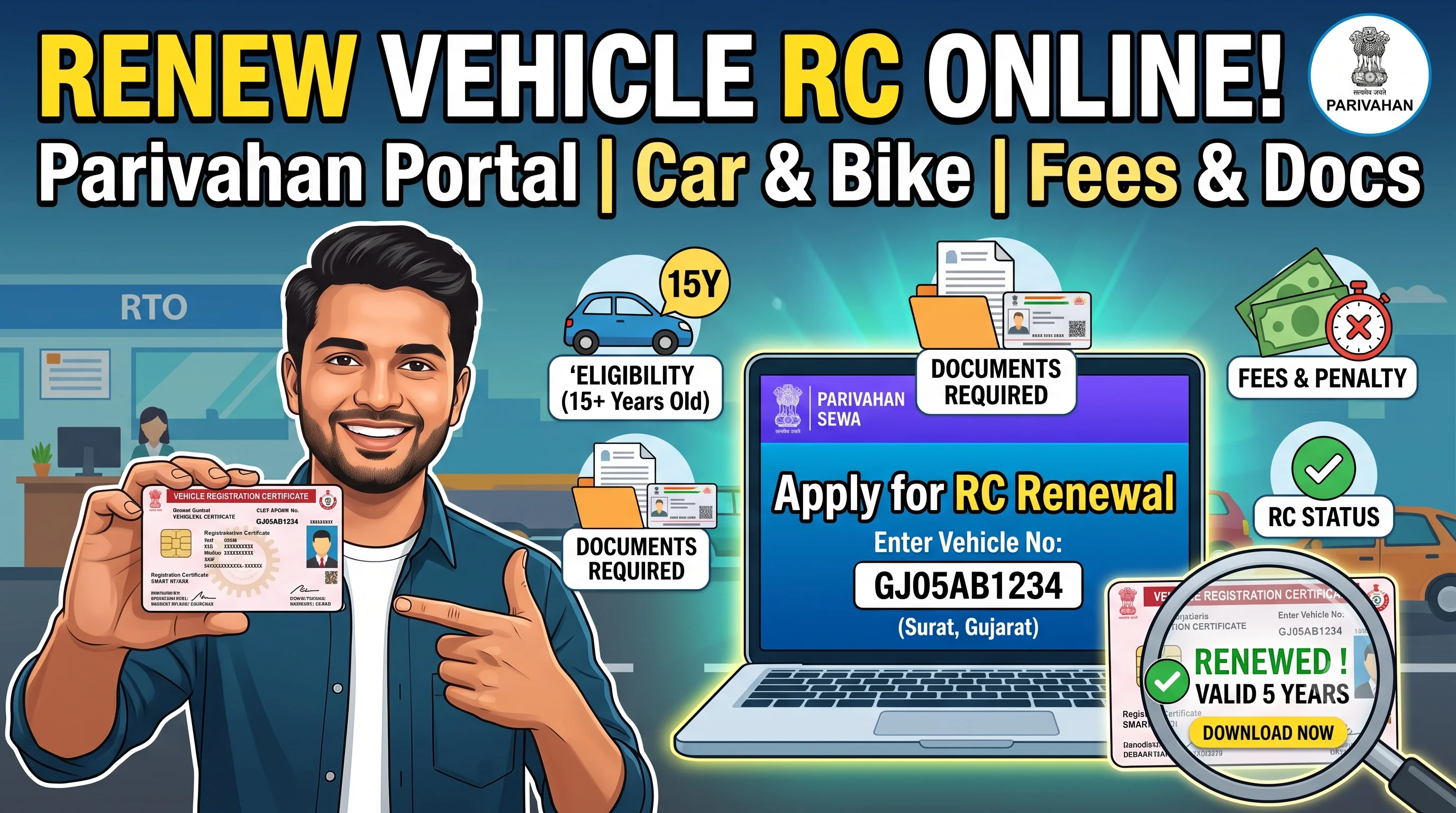
Start renewal on the official Parivahan portal
Opens the official Parivahan portal in a new tab.
Quick Answer
RC Renewal is the process of extending the validity of your vehicle's Registration Certificate (RC) after it expires. Vehicle owners can apply online through the official Parivahan portal by completing document verification, paying the applicable fee, and undergoing vehicle inspection where required. Once your application is approved, you can Check RC Status to monitor the application and Download RC Online after the renewed Registration Certificate becomes available.
RC Renewal at a Glance
| Details | Information |
|---|---|
| Service | RC Renewal |
| Applicable For | Cars, Bikes, Scooters, Commercial Vehicles |
| Mode | Online & Offline |
| Portal | Parivahan |
| Authority | Regional Transport Office (RTO) |
| Processing Time | Varies by State |
| Vehicle Inspection | May be Required |
| RC Download | Available after Approval |
| RC Status | Can be Tracked Online |
Table of Contents
What is RC Renewal?
A Registration Certificate (RC) is one of the most important legal documents issued by the Regional Transport Office (RTO). It proves that your vehicle has been officially registered under the Motor Vehicles Act and is legally permitted to operate on Indian roads.
However, a Registration Certificate is not valid forever. Every vehicle is issued an RC with a specific validity period. Once this validity ends, the vehicle owner must apply for RC Renewal to continue using the vehicle legally.
The RC Renewal process confirms that your vehicle still complies with applicable transport regulations and, where required, passes the necessary inspection. After approval, the validity of the Registration Certificate is extended according to the rules applicable to your vehicle category.
Before starting the renewal process, it is advisable to Check RC Detailsto ensure that information such as the owner's name, address, engine number, chassis number, and registration details are accurate. Incorrect information can delay approval and may require you to complete the RC Correction Process before the renewal application can be processed.
Why is RC Renewal Important?
Many vehicle owners assume that renewing their RC is simply another government formality. In reality, it plays an important role in maintaining the legal status of your vehicle.
Driving with an expired Registration Certificate may lead to penalties, delays during insurance claims, complications while selling the vehicle, and issues when applying for other RTO services.
Timely renewal helps you:
- Continue driving legally.
- Keep your registration records updated.
- Avoid penalties for expired registration.
- Simplify insurance renewals.
- Complete ownership transfers without delays.
- Maintain accurate government records.
- Access digital vehicle services without interruption.
If your Registration Certificate has already expired, begin the renewal process as soon as possible. After submission, you can regularly Track RC Status to monitor verification, approval, and document generation.
Who Needs RC Renewal?
Not every vehicle owner needs RC Renewal immediately. The requirement depends on factors such as the type of vehicle, its age, and the validity period mentioned in the Registration Certificate.
Generally, RC Renewal is required by:
- Private car owners.
- Motorcycle owners.
- Scooter owners.
- Commercial vehicle operators.
- Taxi owners.
- Bus operators.
- Truck owners.
- Fleet management companies.
For commercial vehicles, renewal requirements may also depend on the validity of the Vehicle Fitness Certificate. If the fitness certificate has expired, it should be renewed before or along with the Registration Certificate renewal process.
When Should You Renew Your RC?
One of the most common questions vehicle owners ask is:
"Should I wait until my RC expires?"
The answer is No.
Waiting until the last day increases the risk of delays caused by document verification, inspections, or missing paperwork.
A better approach is to begin preparing your application before the expiry date so there is enough time to resolve any issues.
Expert Tip
Start collecting your documents 30 to 60 days before the RC expiry date. This gives you enough time to renew insurance, update your Pollution Under Control (PUC) certificate, correct any registration errors, and complete vehicle inspection if required.
This simple step can save you from unnecessary penalties and repeated visits to the RTO.
How to Check Whether Your RC Has Expired
If you are unsure about your Registration Certificate validity, there are several easy ways to verify it.
You can:
- Check the physical RC Book.
- View the digital RC in mParivahan or DigiLocker.
- Verify the validity through the Parivahan portal.
Use the online RC Details service to view the registration validity date.
If you have already submitted a renewal request, use RC Status to track whether your application is under verification, approved, or ready for download.
RC Renewal After 15 Years
For many private vehicles, the initial Registration Certificate remains valid for up to 15 years from the date of first registration.
After this period, the vehicle owner must apply for renewal as per the applicable transport regulations. Depending on the vehicle category and local RTO requirements, the renewal process may involve:
- Document verification.
- Payment of the prescribed renewal fee.
- Inspection of the vehicle.
- Verification of insurance and PUC.
- Approval by the Regional Transport Office.
Once approved, the renewed Registration Certificate reflects the updated validity period.
You should then Download the Updated RC to keep a digital copy of your renewed Registration Certificate for future reference.
Can You Renew RC Before Expiry?
Yes.
In fact, applying before the expiry date is considered good practice.
Applying early provides several benefits:
- Avoids last-minute document issues.
- Prevents penalties.
- Ensures uninterrupted vehicle usage.
- Makes insurance renewal easier.
- Reduces processing stress.
If your vehicle information has changed—for example, after an address update or owner name correction—you should complete the required RC Update or RC Correction process before submitting the renewal request.
RC Renewal After Expiry
Many vehicle owners realize that their Registration Certificate has already expired only when they attempt to sell the vehicle, renew insurance, or complete another RTO service.
If your RC has expired:
- Do not ignore the expiry.
- Begin the renewal process immediately.
- Prepare all required documents.
- Ensure your insurance is active.
- Confirm your PUC certificate is valid.
- Complete inspection if required.
Delaying the renewal further may result in additional penalties or procedural requirements depending on your state's transport regulations.
Frequently Asked Questions
RC Renewal is the process of extending the validity of your vehicle's Registration Certificate (RC) after it expires. It ensures your vehicle remains legally registered for use on public roads.
You should apply for RC Renewal 30–60 days before the Registration Certificate expires to avoid penalties and processing delays.
Yes, you can renew an expired RC. However, late applications may attract additional charges or require extra verification depending on RTO rules.
You can track your application through RC Status to see whether it is under verification, approved, or ready for download.
Yes. After approval, you can Download RC Online and access the updated digital Registration Certificate.
Yes, vehicle inspection may be required depending on the vehicle type and applicable transport regulations.
Generally, you need the existing RC, valid insurance, PUC certificate, identity proof, address proof, and the prescribed application form.
The RC Renewal fee depends on the vehicle type, age, and applicable state transport rules.
Processing time varies by state and RTO workload. You can monitor progress using RC Status.
No. Driving with an expired Registration Certificate may result in penalties and legal issues. Renew your RC before the expiry date.
Yes. Many states allow RC Renewal through the official Parivahan portal, although some applications may require an RTO visit for inspection.
Check the rejection reason, correct the issue, and reapply. If your RC contains incorrect information, complete RC Correction first.
Commercial vehicles usually require a valid Fitness Certificate, while requirements for private vehicles depend on applicable rules.
Yes, but the vehicle ownership should first be updated through RC Transferif it hasn't already been transferred.
Update incorrect information through RC Correction or RC Update before applying for RC Renewal.